Through Vienna in a horse-drawn carriage
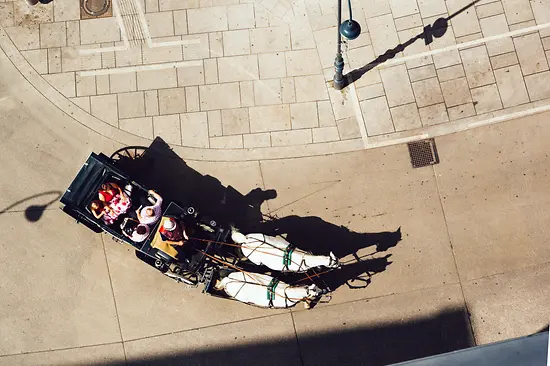
The term "fiaker" originates from the French and refers to the hackney carriage stand in the Parisian Rue de Saint Fiacre. In 1720, the carriages - which had previously been referred to as "Janschky" coaches in Vienna - were renamed "fiakers" (and numbered).
Then the carriage trade really began to boom: more than 1,000 fiakers were on the road in Vienna between 1860 and 1900. The carriage drivers were often characters that were known throughout the city and also sometimes performed as singers. They were appreciated for their discretion, especially when one or the other fine gentleman was amusing himself in the fiaker with his paramour. Probably most famous among them was Josef Bratfisch, the royal coachman of Crown Prince Rudolf, who brought the prince's lover Mary Vetsera to Mayerling in 1889, where both lives found a tragic end.
City center, Vienna Central Cemetery, Schönbrunn
Today it is hard to imagine the cityscape without the Viennese fiakers. You can find horse-drawn carriage stands in different areas of the city: Stephansplatz, Michaelerplatz, Albertinaplatz, Petersplatz and Burgtheater/Volksgarten. The short tour (approx. 20 min. through the centre of the Old City) costs € 60; the long tour (approx. 40 min. through the Ringstrasse and the Old City) € 105. You can also book individual sightseeing tours directly through the fiaker companies.


Horse-drawn carriage rides are also possible at the Central Cemetery: the carriage rank at gate 2 is occupied daily from 10.00 am to about 5.00 pm. The tour includes numerous memorial graves of prominent Viennese personalities (Mozart, Schubert, Beethoven, Hans Moser, Falco, Adolf Loos and many others), and also brings visitors closer to the cemetery's natural attractions. The short tour (30 min.) costs €65.00, the long one (60 min.) €110.00 per carriage (for 4 people). Rides operate from mid-March to November 1. Reservations on tel. +43 (0)699-181 540 22
“Fiaker” horse-drawn carriage rides through the Schönbrunn Palace Park are also available. These rides are available from late March to late October. The tour through the palace park takes about 30 minutes and costs €95. The carriage stand is located right in front of Schönbrunn Palace, in the Ehrenhof. You can find all the information on Fiaker Paul’s website.
Exclusive horse-drawn carriage experiences
During the tour "Secrets of the horse-drawn carriages", visitors are first taken on a guided tour of the stables on the outskirts of Vienna. On the premises of Fiaker Paul, you will learn interesting facts about horses and coachmen. Afterwards, a horse-drawn carriage takes visitors directly to the city center. Daily departures at 8:45 am; meeting point at Rappachgasse 34a, corner of Wachthausgasse in the 11th district. Prices and booking
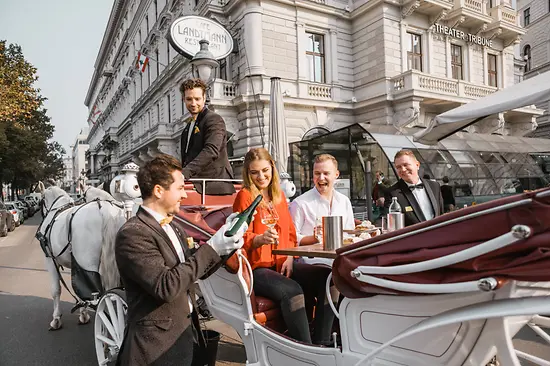
Riding Dinner also offers exclusive culinary horse-drawn carriage rides for one to four people through the city center. Food and drinks are procured from traditional Viennese restaurants and coffee houses such as Zum Schwarzen Kameel and Café Landtmann. Information, prices and booking: wien.ridingdinner.com


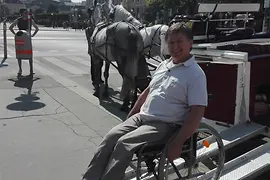
Horse Drawn Carriages for Wheelchair users
For wheelchair users and with an accompanying person in special carriages (wheelchairs: max. width 68 cm)
Ascent, route and travel time by arrangement, price per hour: 160 Euro;
Hudusan KG (Karl Neubauer), 2., Freudenau 65 Nr. 15
Contact: Fiaker Susi (Susanne Trummer)
Mobile: +43 699 10602935
Only by prior arrangement!
For guests who can still take two small steps (with support), a second stage can be installed and you can sit comfortably on the bench. The wheelchair remains safe at the stand (but can also be carried when there is enough space). Round trips take place outside of the high-hours Mo-Thurs 11-18.00, because it means an extra time effort. Fri, Sat, Sun Departure exclusively 10.00 (no surcharges). The round trips start at the Burgtheater, enough space and rest to get on and off by ramp. Parking facilities around the Burgtheater available. Rides in the Prater/Lusthaus on request.