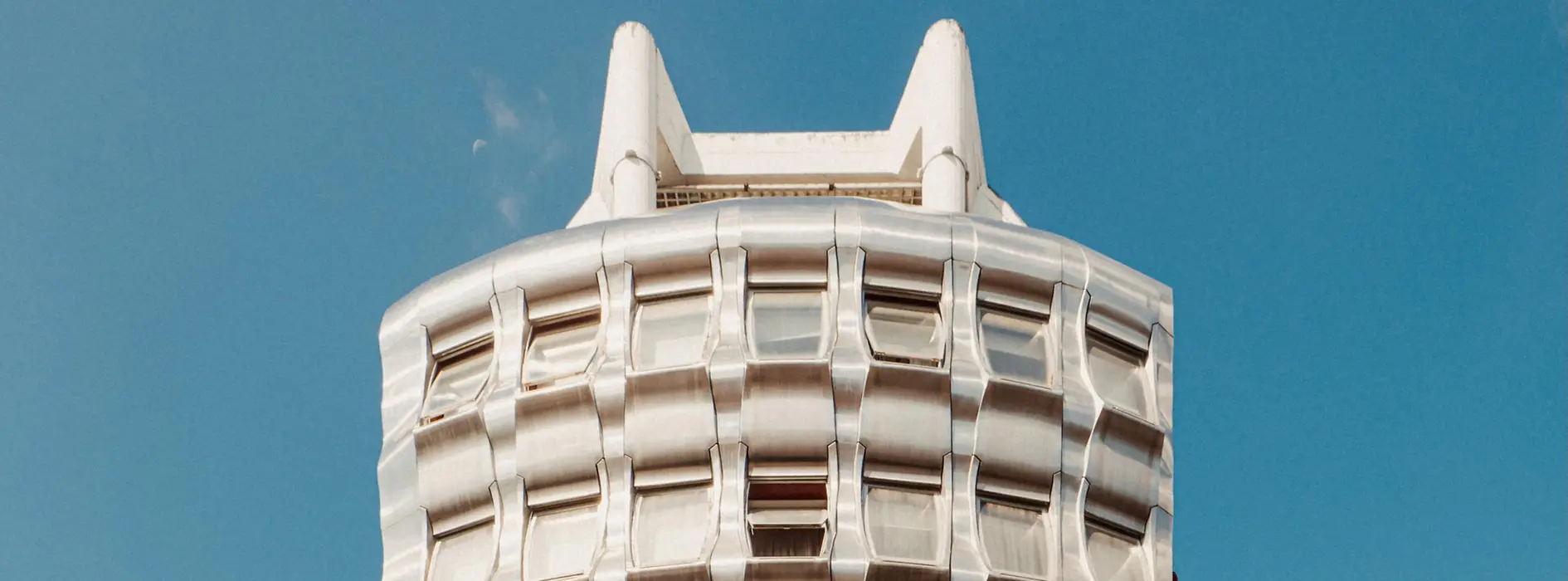
Domenig-Haus: Radical Building
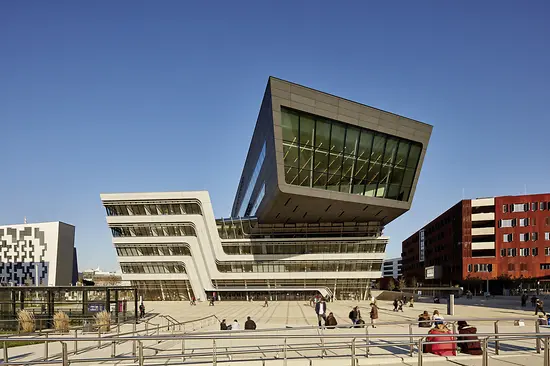
Some call it a “crashed spaceship”, others think that they can spot a caterpillar in the facade. In 1970s Vienna, it was dubbed “Tin Gaudí” in reference to the work of Antoni Gaudí. But what did Günther Domenig (1934-2012) himself, one of the most significant Austrian architects of his time, have to say about it? Referencing the articulated facade, created between 1975 and 1979, he called it the “House with the bend” singling out the folds on the building’s facade. It not only aptly describes the building’s appearance but also Domenig’s building philosophy: he sought to bend the rules, his gaze firmly fixed on the future. He even once referred to himself as an extremist.
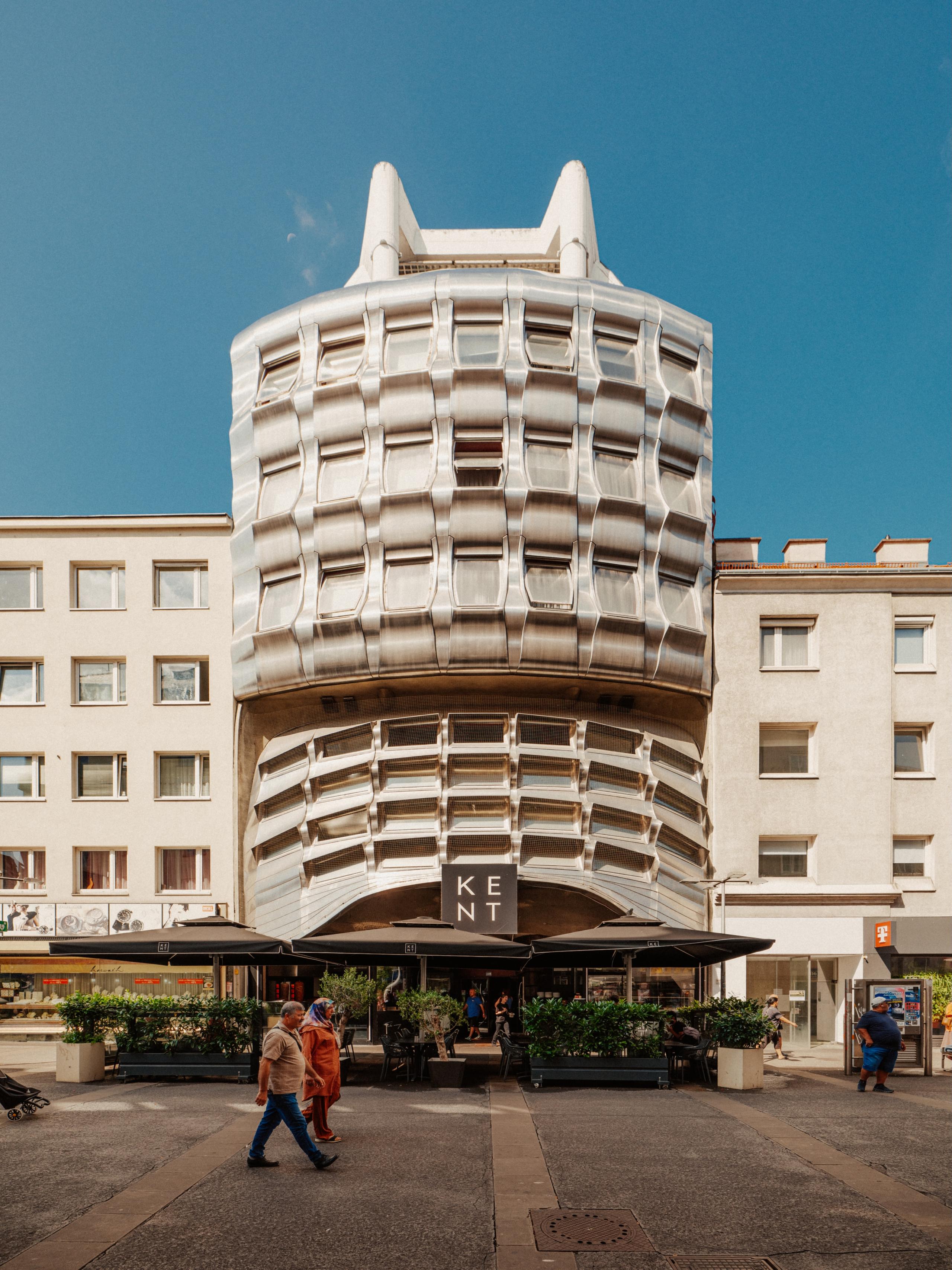
With great success: the Domenig-Haus, one of the architect’s major works, made waves worldwide at the time. From Tokyo to Milan, everyone was talking about the building. The architectural world was captivated by the extreme design – Vienna’s residents were, naturally, more skeptical. It is a sculpture-like building. And not just on the outside. Inside, biomorphic forms dominate too. Right angles and straight lines are nowhere to be found.
Bones, Sinews and Skins
This revolutionary architectural feat was only made possible by the cooperation of a particularly open-minded client. The then-director of the City of Vienna’s now-defunct Zentralsparkasse, Karl Vak, saw enabling contemporary art and culture as part of the role of a bank. He wanted Domenig to create a radical bank building that signaled the institution’s progressive thinking through innovative architecture. And that is precisely what he got. Domenig created an organ-like body with biomorphic structures that were meant to evoke bones, sinews, and skins. This particularly applied to the prominently displayed ventilation ducts inside the building which snake through the first two floors like veins. Like the facade, the ducting was put under a heritage protection order in 2005. But the commercial banking that once played out inside is now a historical footnote.
Urban Renewal Spirit
The building was used as a publishing house in the 2000s and then as a gallery. After standing vacant for some time, the Domenig House was dedicated to culinary arts from 2022 to 2026; however, the interior can currently only be viewed as part of guided tours.
But the building is a great opportunity to explore life in Vienna outside the city center. The Domenig-Haus – located on Favoritenstrasse in the multicultural 10th district – is right next to the Keplerplatz U1 station. An important part of the history of public transportation in Vienna, this section of the subway opened in 1978 and was Vienna’s first entirely newly built underground line. And at the same time, Favoritenstrasse became one of Vienna’s first major pedestrian zones, and one of the defining examples of the spirit of urban renewal that prevailed at the time. All eyes were on the future. And it is in this context that the Domenig-Haus must be seen – a building that shattered all architectural conventions.
Text: Johannes Luxner
- Favoritenstraße 118, 1100 Wien