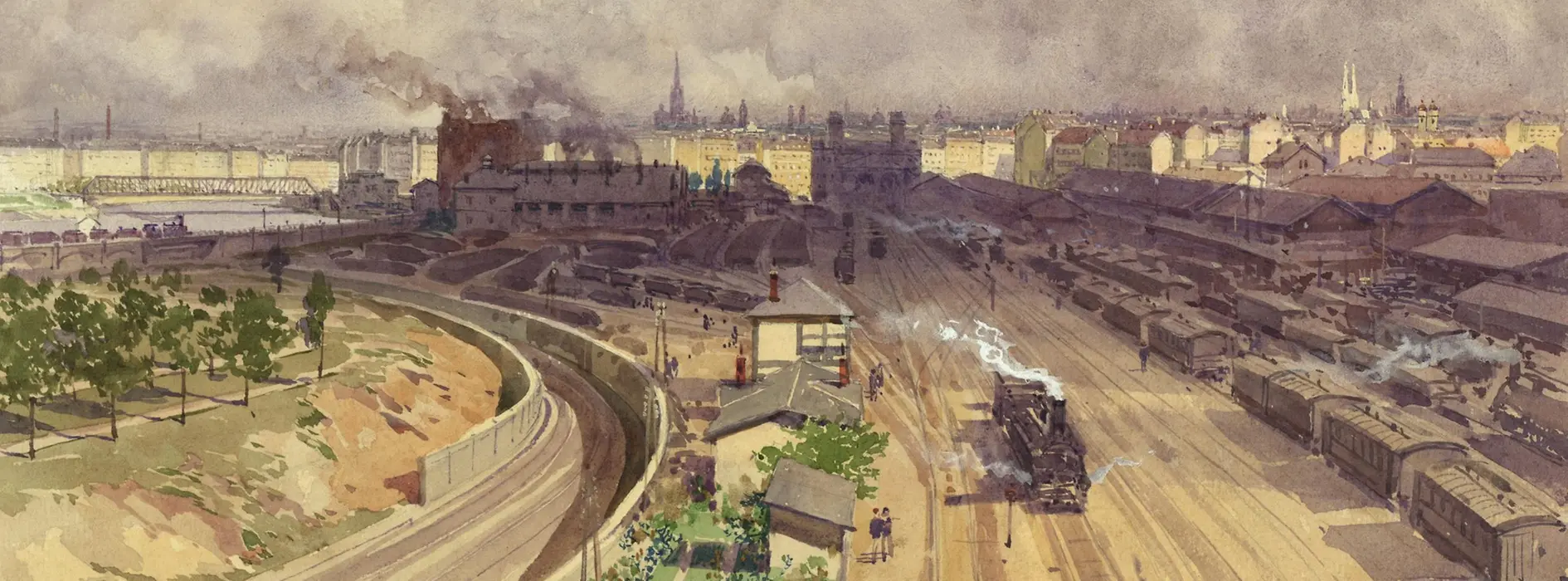
Empire on Track: How Vienna became a Rail Hub
1838
1838 Austria's first public steam-powered railway line runs from Vienna’s Nordbahnhof station to Deutsch-Wagram, roughly 19 kilometers away. This was the Kaiser-Ferdinand-Nordbahn (Emperor Ferdinand Northern Railway). Lasting roughly 25 minutes, the journey – crossing two newly constructed wooden bridges over the Danube and passing through the rather monotonous plains of the Marchfeld region on the city’s outskirts – was promoted as a sightseeing excursion. But it was not so much the scenery that sparked true amazement but the revolutionary technology: a machine capable of traveling without horses, moving at unprecedented speeds while producing an unfamiliar noise and billowing thick clouds of smoke into the air. Only precious few, however, could afford the luxury. A first-class ticket cost a hefty 50 kreuzer, while third class still ran to 15 kreuzer. By way of comparison: unskilled labor in Vienna paid around 60 kreuzer for a 12- to 14-hour workday.
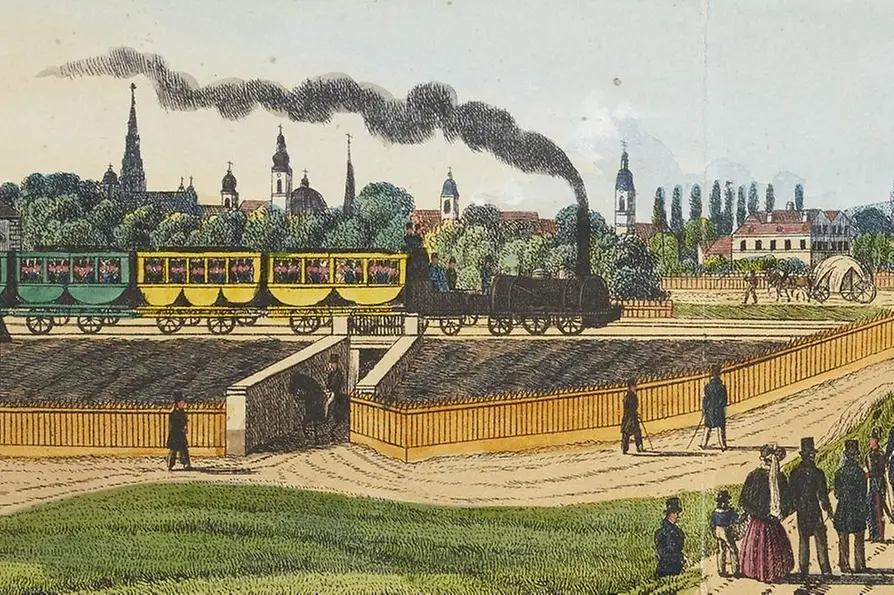
More Rails for the Realm
During the early 19th century, Great Britain was tracking well ahead of continental Europe when it came to rail development. Viennese geologist and mining expert Franz Xaver Riepl studied English construction techniques on the British Isles, eventually convincing banker and entrepreneur Salomon von Rothschild to finance the ambitious – and highly costly – Nordbahn railway project. Sourced from northern England, the first six steam locomotives had to be laboriously dismantled into their constituent parts before being shipped to the Adriatic port of Trieste and transported to Vienna on heavy horse-drawn wagons.
In fact, transporting freight was the main purpose behind the majority of the rail routes built at this time. By 1848, the Nordbahn route extended all the way to Kraków in present-day Poland. Rich coal deposits from the region were shipped directly to Vienna to power its steam engines – alongside salt, fresh produce and other goods destined for the city’s affluent population. The Empire drew closer together and the economy flourished, as did rail traffic – which rapidly gained strategic importance for military troop movements as well. During the Battle of Königgrätz in 1866 (in what is now the Czech Republic), where Austria suffered defeat against Prussia, single-track bottleneck routes and the inefficient coordination of multiple private railway operators severely hindered troop deployment. Consequently, the Empire stepped in to take control, nationalizing thousands of kilometers of track in the process.
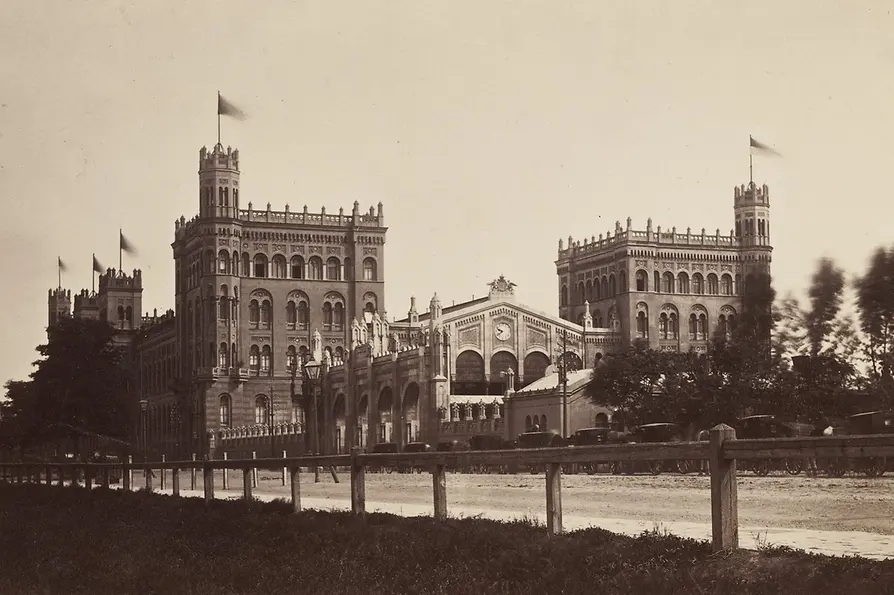
Radiating outward from Vienna, a rail network took shape in the second half of the 19th century that continues to define European transit routes today. Travel – along with the cultural and social exchange it enabled – became faster, easier and, for many, possible for the very first time. The Semmering Railway, which was the world’s first standard-gauge mountain railway, connected Vienna with the Mediterranean and its strategically vital sea port in Trieste. While horse-drawn carriages took many days to make the trek, express trains could now transport holidaymakers to the Adriatic coast in just 15 hours. The Kaiserin-Elisabeth-Bahn (Empress Elisabeth Railway) ran from the Westbahnhof station to Salzburg. Lines were built from Franz-Josefs-Bahnhof and Nordwestbahnhof to Prague, opening up direct routes to Berlin. The Staatsbahnhof station served as the gateway to the East. And all these lines shared one common feature: they terminated at grand Viennese railway stations, leading straight into the heart of the monarchy, the center of power. To Vienna.
Signs of the Times
Vienna set the political pace for the realm – and its standard time too. Previously, local solar time applied throughout the Empire based on local high noon. This created a logistical nightmare for rail and postal networks because it made precise scheduling virtually impossible. To establish Empire-wide standardization, in 1872 the University Observatory in the center of Vienna began its practice of telegraphing a noon signal to every station in the monarchy at the stroke of 12:00 midday.
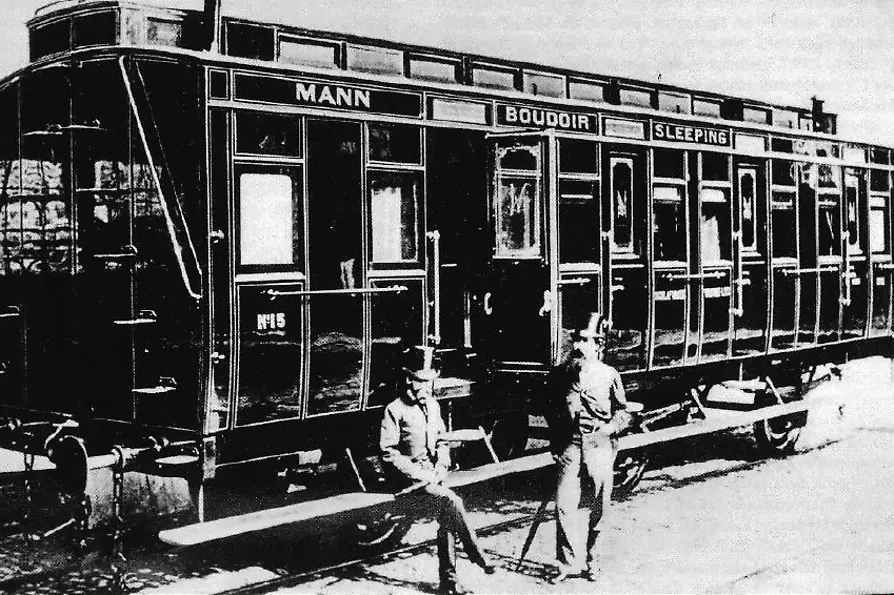
Vienna was expanding rapidly. By the outbreak of World War I in 1914, the population of the city had surged to almost 2.2 million – a fivefold increase since 1838, and a higher figure even than today. Hundreds of thousands arrived by train from surrounding rural areas and Kronländer (the individual territories that made up the Habsburg Empire) via newly laid tracks during the late 19th century, drawn to Vienna by the prospect of employment. Major engineering projects – such as the first major regulation of the Danube, construction of the First Vienna Mountain Spring Pipeline, and expansion of the municipal sewer system – were direct responses to this massive influx. The city continues to benefit from this 19th-century infrastructure to this day. And it was the railways that made it all possible, delivering bricks, stone, labor – and visitors, too. One of Europe’s earliest night-train sleeper services began operating between Paris and Vienna in 1874. Luxurious for the era, they featured full lie-flat beds and even a proper lavatory – even if the WC in question only consisted of a simple drop chute that discharged directly onto the tracks.
The end of World War I in 1918 brought 636 years of Habsburg rule to an end, along with the rail empire that sustained it. Designed to bind the Empire together, the carefully constructed rail network was suddenly truncated – cut short by international borders. Amid efforts to bring order to chaos, newly established nations created their own state railway companies, among them the Austrian Federal Railways (ÖBB) in 1923. Its most immediate challenge was to source what was needed to power the enterprise. Having lost access to the coal fields as they were now located outside its new borders, the young republic turned to Austria’s natural geography – embracing hydroelectric power to electrify its rail network. To this day, ÖBB operates nine company-owned hydroelectric power stations across Austria, which supply roughly one-third of its total electricity demand.
2027
The larger Habsburg legacy is still highly visible – and palpable – all over Vienna today. But when it comes to the rail sector, it requires a closer look. The grand arrival halls and impressive terminal stations that once welcomed millions to the imperial capital were destroyed during the two world wars of the 20th century. Although the Franz-Josefs-Bahnhof and Westbahnhof stations still stand on their original sites, their modern exteriors bear no resemblance whatsoever to the original architecture. Where the Nordbahnhof station and the Südbahnhof freight yards once stood, vibrant new urban residential quarters such as the Nordbahnviertel and Sonnwendviertel are now home to thousands of people instead. Opened in 2014, Vienna's main station (Hauptbahnhof) is sleek and functional – representing the city’s world-class modern infrastructure rather than imperial nostalgia. Nearly one in three visitors to Vienna now arrives by train, a share that is growing all the time. Around 1,100 trains move through the Hauptbahnhof daily – including up to 20 Nightjet sleeper trains.
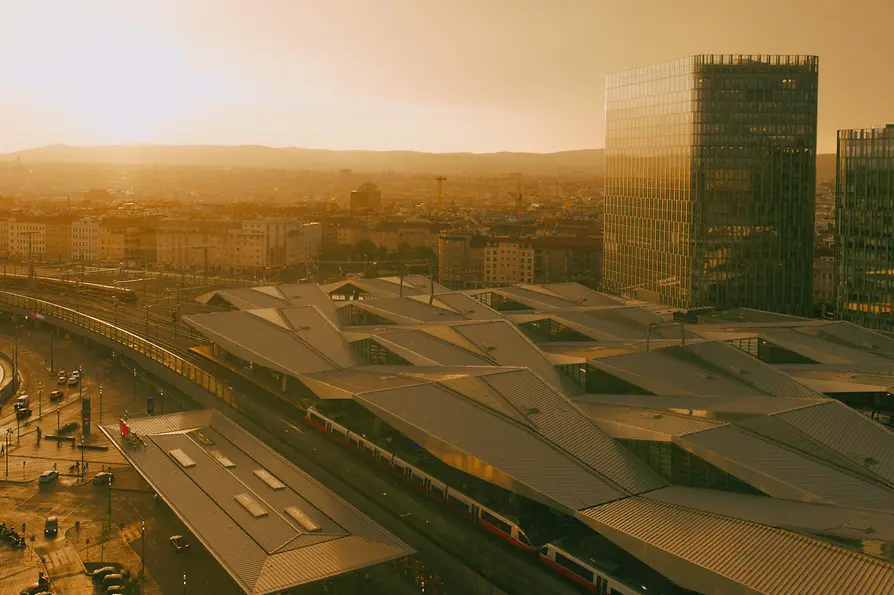
Im Nachtzugverkehr ist Wien wieder das Herz des vereinten Europas. Stolze 15 Enddestinationen sind über Nacht per Schiene erreichbar – mehr als von jeder anderen europäischen Stadt. Die neue Generation der Waggons bietet wesentlich mehr Komfort als die Schlafwagen von 1874 und machen damit auch dem Flugverkehr ernsthafte Konkurrenz. Auch wenn die Züge immer noch die Strecken von damals befahren, so hat sich eines gravierend verändert: Schienen sind heute kein Symbol mehr für Macht – sie sind ein Symbol für Freiheit geworden.
As far as European night-train travel is concerned, Vienna has reclaimed it status as the beating heart of an interconnected continent. An impressive 15 final destinations can be reached overnight by rail – more than from any other European city. The latest generation of sleeper trains offers comfort far beyond those original 1874 carriages, posing a genuinely viable alternative to air travel. Though trains still travel along many of the same routes that were laid down more than a century ago, one fundamental shift has occurred: railway tracks no longer serve as a symbol of power – they have become a symbol of freedom instead.
- Am Hauptbahnhof, 1100 Wien
- hauptbahnhofcity.oebb.at
Accessibility
no steps
on Karl-Popper-Straße and on Sonnwendgasse across the south forecourt
Parking spaces for people with disabilities
Accessible toilet
Inductive hearing systems are available. Request assistance on the platform for wheelchair users: Tel. +43 (0)5 1717 menu item 5, email: mobilitaetsservice@pv.oebb.at