The Emperor’s Gift of a Garden
Carved in stone above the entrance since 1775 are the words: “A Place of Recreation Dedicated to All People by Their Esteemer”. The 'Esteemer' in question here was Emperor Joseph II. To this day the place has remained what it was intended to be: somewhere for everyone to enjoy. The Augarten still upholds the emperor’s promise – as a place for concertgoers and school classes, for porcelain enthusiasts and open-air cinema fans, for amateur gardeners and anyone who simply wants to sit under horse chestnut trees surrounded by greenery.
The Emperor’s Gift to the people
That Joseph II would enter the history books with his decision to open up the grounds to the public on May 1, 1775, is undisputed. But what he managed in the process was to pull off a remarkably effective PR coup. Even before that historic day, the Augarten was far from some kind of off-limits imperial domain: in reality, distinguished visitors, travelers and people out for a walk were already allowed to enter the grounds. What the Emperor did was a masterstroke: he accepted the status quo, turned it into an official gesture of generosity – and, in honor of the occasion, released nightingales that were not to be hunted under the threat of punishment. Vienna received its first public imperial park, the nightingales received protection and Joseph II secured his place in history.
A lap of honor
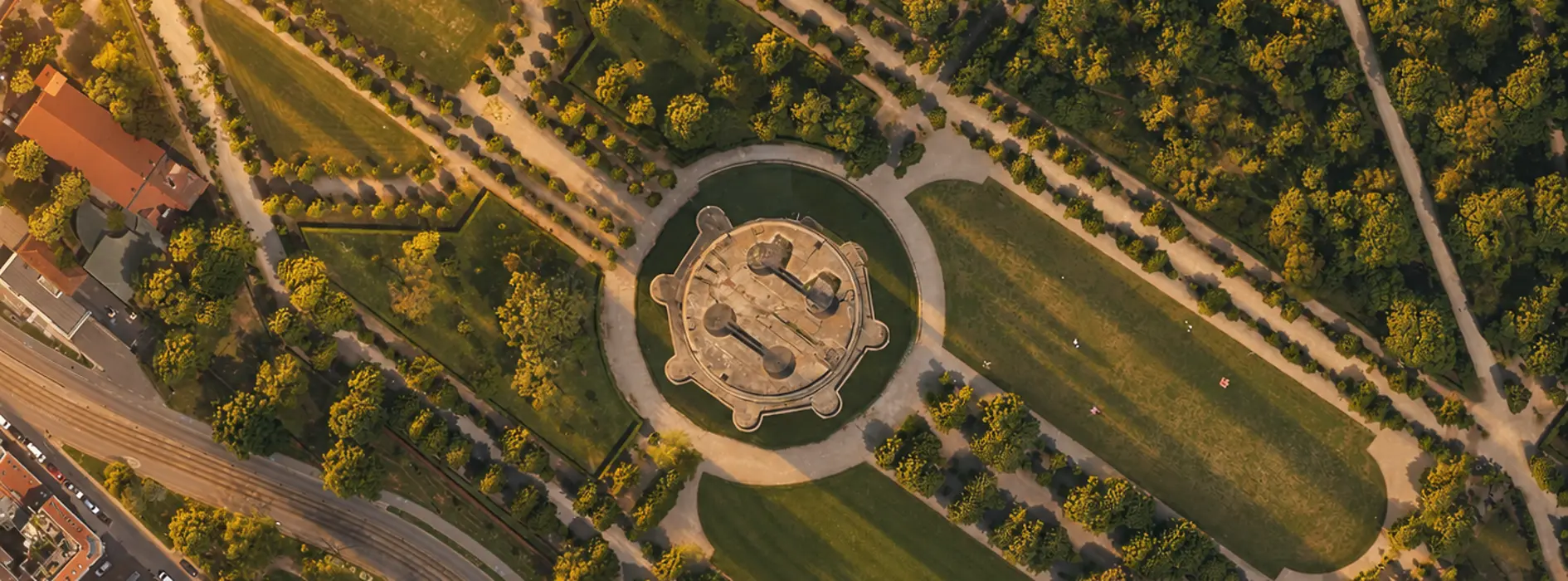
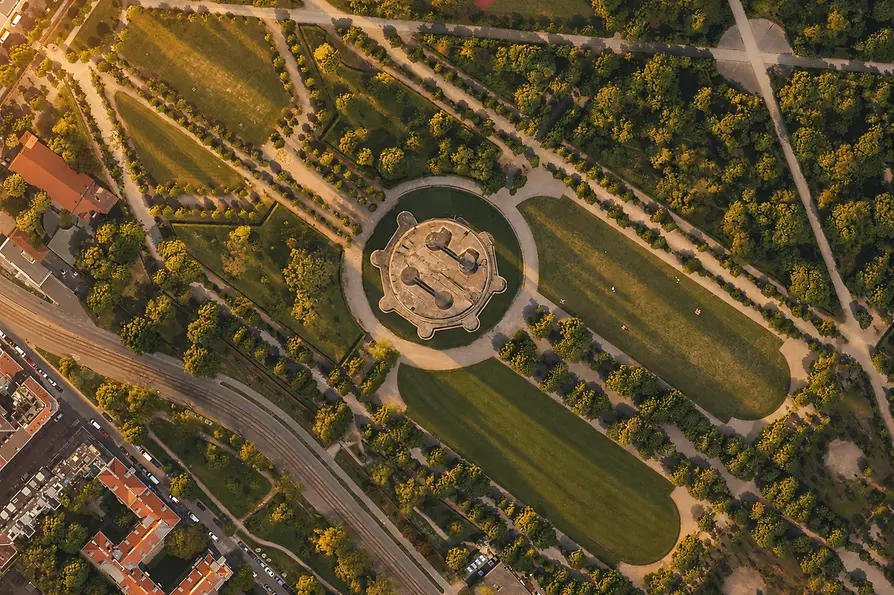
Anyone who takes a stroll through the Augarten today will immediately sense the history of the grounds. The Baroque gardens – laid out in 1712 in the French style, the oldest surviving grounds from this era in Vienna – are characterized by long lines of sight framed by splendid avenues radiating star-like from a single point, giving the kind of symmetrical rigor that faces down the restlessness of the city. None of this is accidental, but rather top-tier European garden architecture. Jean Trehet (the same man behind the Schönbrunn Palace Gardens) started work on the grounds in 1705, taking up an imperial commission to undo the damage visited on the site by the Ottomans in 1683 during the second siege of Vienna. By and large, what first took shape back then is still identifiable today. Heritage-listed since 2000, it is anything but an open-air museum.
The main walking loop covers about 2.3 kilometers of tree-lined avenues, and takes in all the highlights along the way: the grand entryway with Joseph’s inscription, the famous Augarten porcelain manufactory, the Palace of the Vienna Boys Choir, playgrounds and sports fields, the family open-air pool, the flak towers, and various places to eat and drink. The best approach is simply to set off without any particular plan in mind. That way, people are likelier to experience more than they expected.
Local residents use the park landscape of the Augarten as a regular home from home, the vast green space living up to its purpose as a garden for all. Many also drop by from local neighborhoods including the adjoining Karmeliterviertel, whose Jewish history can still be felt today and where religious groups and communities of all kinds live side by side in perfect harmony.
Mozart’s morning concerts
The Baroque palace opposite the main entrance is today home to the Vienna Porcelain Manufactory Augarten. But history has this place down as an important musical stage: it was in the garden room of the same palace, on May 26, 1782, that the first of the famous morning concerts took place, under the baton of none other than Wolfgang Amadeus Mozart. Ludwig van Beethoven also had several of his works performed here, and between 1820 and 1847 it was mainly Johann Strauss the Elder who held sway in the garden hall. The Augarten always was an elite European center of music, long before the Vienna Boys Choir opened their MuTh concert hall there. Though the morning concerts have since been consigned to the realms of history, their erstwhile imperial setting hosts a cultured tenant that also claims a place at the top table. Today, the focus is very much on high-quality craftsmanship.
Augarten Porcelain Manufactory
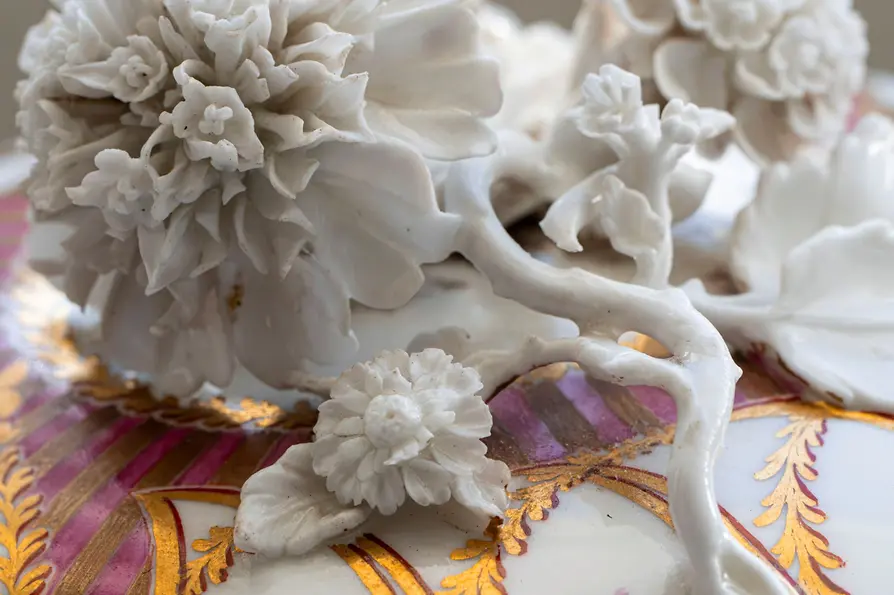
Founded in 1718, Vienna’s Augarten Porcelain Manufactory is the second-oldest porcelain manufactory in Europe, and has been based in the Augarten since 1923. Porcelain was regarded as something almost immeasurably valuable; the courts of Europe collected it almost obsessively. People even referred to it as ‘white gold’. Ever since the days of Maria Theresa – who took over the manufactory in 1744 and adored its porcelain with a passion, reflected in delicate figures, rocaille ornamentation and floral motifs – every piece has borne the Bindenschild, once the coat of arms of the former Babenberger rulers, beneath the glaze.
The classic Biedermeier ‘Wiener Rose’ table set and the world-famous “Melone” service by Josef Hoffmann from 1929 remain bestsellers to this day. In addition to legacy designs, there are exciting new collections from contemporary creators who are building on a 300-year tradition.
Tours of the workshops offering a glimpse into the creative process are highly recommended. All of the porcelain is made by artisans, not machines, using methods established in the 18th century. Casting, firing, freehand painting – everything’s handmade, unhurried, created by craftspeople who approach their material with a calm that can seem like a throwback to bygone days, which is precisely the source of its appeal.
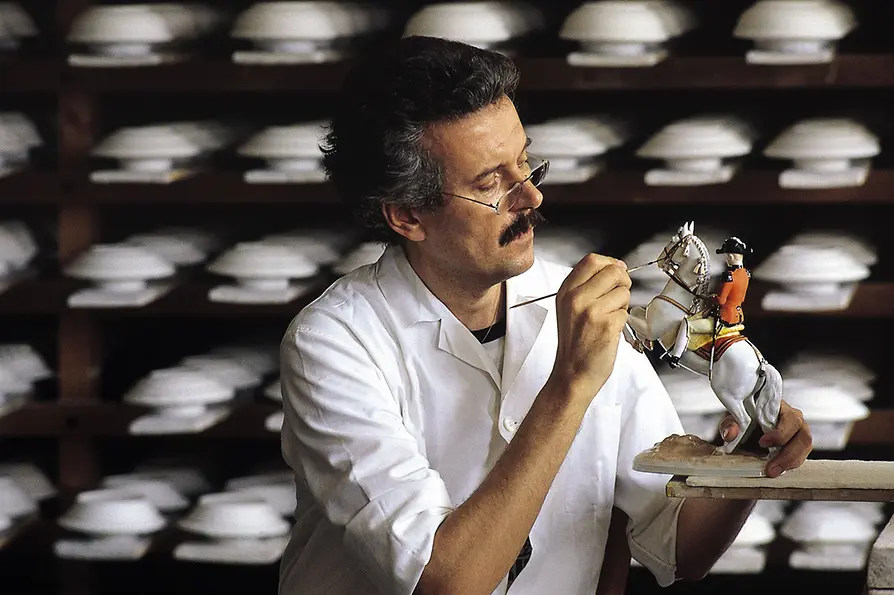
In the former ballroom of the Summer Palace, the Porcelain Museum at Augarten, centered around the original kiln from 1923, traces the design and cultural history of Viennese porcelain from its beginnings in the 18th century to the present day. From March 18, 2027, through February 26, 2028, the special exhibition “Im Grünen” (In the Green) will focus on the Augarten as an exemplary 18th-century pleasure garden, featuring a world of greenery immortalized on porcelain.
Vienna Boys and Girls Choir
The Augarten Palace, an elegant Baroque building not far from the porcelain palace, has been home to a world-famous institution since 1948: the Vienna Boys Choir. They are often called Vienna’s youngest ambassadors. And the fact that they are housed in a former imperial palace says a lot about the character of this city: rather than being preserved and shut away behind glass, this imperial setting is alive and kicking through children’s laughter and voice exercises, in its present-day incarnation as a secondary school with dorms for boarders.
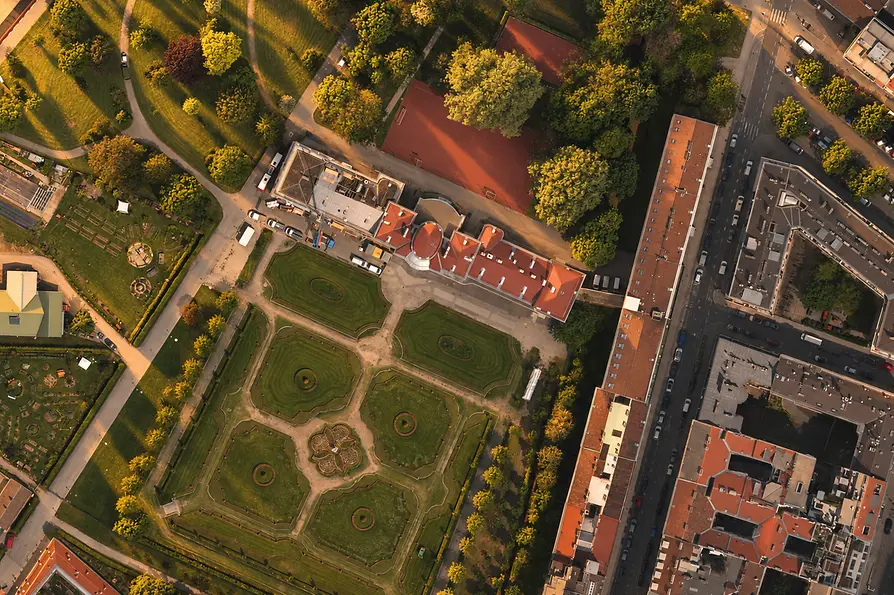
North of the Augarten Palace stands the Kaiser Joseph Stöckl, an annex dating back to 1780. It serves the Boys Choir today as a music elementary school. In 2012 a new venue, the Vienna Boys Choir concert hall MuTh (a portmanteau of Musik und Theater), was added at the southern tip of the Augarten. It seats 400 persons in a cinema-style layout. Besides exceptionally good sightlines to the stage, MuTh’s outstanding acoustics are a major plus point. And on stage the performers have almost as much space as they would at the Vienna State Opera. But it’s not just the Boys Choir who perform here. The seasonal line-up is a genuine insider tip for music lovers seeking experiences outside the mainstream.
But focusing exclusively on the Vienna Boys Choir does not show the full picture, given that it has had a female counterpart since 2004. The Vienna Girls Choir – now a chamber choir of 25 singers between the ages of ten and fourteen – is very much in the ascendancy. In 2023, they appeared at the New Year’s Concert of the Vienna Philharmonic. And since September 2024, its members have been admitted to the Vienna Boys Choir secondary school. During the school year they also perform abroad: in 2026, they toured China for three weeks. The members of the Vienna Boys Choir as well as the Vienna Girls Choir form the backbone of the Hofburgkapelle.

Film archive, open-air cinema, al fresco fun
Since 1997, the Filmarchiv Austria has been based in a former imperial kitchen building opposite what is now the MuTh concert hall. Since 2008, it has also run the ‘Kino wie noch nie’ film series in this corner of the Augarten (known as the Augartenspitz) – international films, original versions, summer evenings, blankets on the lawn. Anyone who has ever had the pleasure of lying there on the grass and looking at the screen, with the night sky of Leopoldstadt above, immediately understands why the project has been going for almost two decades now.
Two establishments that could scarcely be more different from one another keep everyone fed and watered in the Augarten. Schankwirtschaft is housed in a former wartime bunker – a stark industrial style that speaks to the park’s history. It is particularly nice here in summer: sitting under shady trees in one of the city’s finest outdoor restaurant spaces.
In the historic palace that houses the porcelain manufactory is Restaurant Sperling, which specializes in contemporary Viennese cuisine made with sustainable ingredients. Its two sun terraces look out over the park. It takes its name from the sparrows that have been native here since imperial times.
Flac towers: concrete reminders
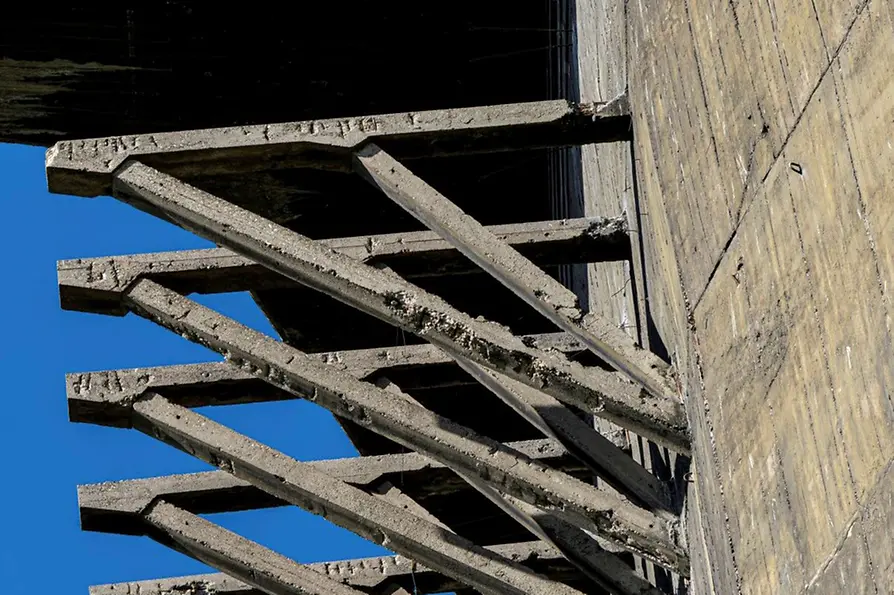
In the middle of the green parkland idyll stand two monumental towers whose striking presence gives every visitor pause for thought – no matter how often they have been here. All of a sudden, these two giants appear among the trees, and for an unsettling moment nothing makes sense: the linden trees, the children, the outdoor seating. And these two gigantic gray buildings, 55 and 51 meters high, from the summer of 1944. The combat tower and the command tower were built as part of the network of flak towers in the Austrian capital that Nazi war strategists tasked with defending the city against air raids. In the late 1960s there was an attempt to blow up one of the towers. But it held firm and remained standing, as an immovable fact, with cracks clearly visible in the concrete. Gray, solid and unsettling. No one ever gets quite used to the sight of the two towers. And that is just as well.
Sports and swimming
There’s a lot going on in the Augarten – in spite of, in front of and inside the historical setting itself. Since 2016 the Association for the Promotion of Park Sports Culture has opened up the Dianawiese to everyone: free of charge, no membership requirement, inclusive. Anyone who wants can use the park’s largest sports ground – covering an area of more than 13,000 square meters – for soccer, basketball, volleyball and badminton.
The Familenbad Augarten pool, now a hundred years old, was created in 1927 as part of a social policy initiative of Red Vienna, when children’s open-air baths were laid out in parks across the city to combat rickets and lung disease. Free for kids, children can splash around to their hearts’ content and have fun on the iconic red elephant slide.
Urban gardening and City Farm Augarten
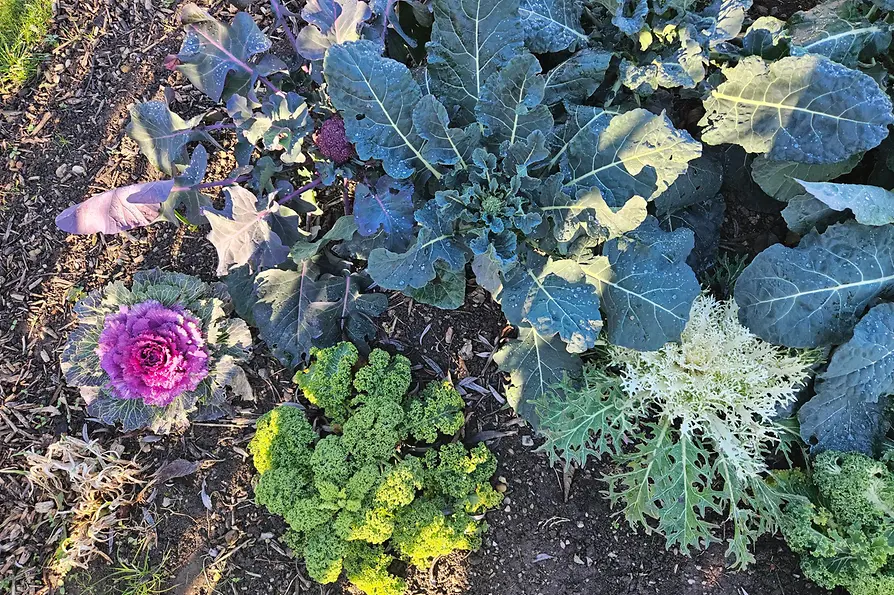
Since 2015 Viennese citizens have cultivated their own plots along Obere Augartenstrasse. With 120 beds on 1,200 square meters up for grabs last time round, spots are allocated by annual lottery. Beside this universal urban gardening project, even more is happening in the way of vegetables: for nine years and counting, the non-profit City Farm Augarten association has been running a hands-on organic garden. Measuring more than 4,000 square meters, this educational space features a show garden and tomato collection. It could be said that the park is not just a hotbed of culture, but freshly-grown produce too. Working away in the background, the Austrian Federal Gardens not only care for the historic garden complex but also operate a tree nursery, cultivation and trial grounds – not all of which is open to the public – as well a training facility for gardeners in the park’s hidden green hinterland.
Atelier Augarten
Rather than the imperial era, the Atelier Augarten provides a rare example of postwar modernism. It was built between 1953 and 1957 as a studio for the sculptor Gustinus Ambrosi and later used by the Thyssen-Bornemisza Art Contemporary foundation. It is currently undergoing a root-and-branch reno which is expected to last until the end of 2027. The aim is to create an open center for contemporary art, culture and social exchange. So building is under way yet again in the Augarten. The complex continues to grow, adding to what’s already there without displacing the old. Here, cultural spaces and park landscapes merge into each other.
That is perhaps the essence of this particular park: that it holds so much history and carries it forward into the future, that it unites so many seemingly contradictory elements. Baroque and brutalism, children’s choirs and silence, white porcelain and old film reels, school sports and summer-night’s cinema, imperial heritage and a municipal open-air pool. All of it coexists on these 52 hectares in the second district, without one layer overshadowing another. The Augarten is not a museum, not a theme park and definitely not just another local recreation area. It is a walk-through cross section of Vienna. Take a close look and the whole city reveals itself, its contradictions, its depth, its creative ability to keep restaging its imperial heritage.
- Obere Augartenstraße 1, 1020 Wien
- www.bundesgaerten.at
- office@bundesgaerten.at
- Karmeliterplatz, 1020 Wien
- Obere Augartenstraße 1, 1020 Wien
- www.augarten.com
- augarten@augarten.at
- wien2@augarten.at
Vienna City Card
Entrance fee manufactory tour with Vienna City Card: 19€ instead of 21€
Opening times
- Mo - Sa, 10:00 - 17:00
Guided tours
Guided Tours in German (English on demand)
Mo, Tue and Thu 10.15 a.m. and 11.30 a.m.
Thu also 14.00 p.m. and 15.30 p.m.
Please register in advance for the guided tours (e-mail to wien2@augarten.at or phone +43 1 211 24-200).
Accessibility
no steps (Double swinging doors)
Assistance dogs allowed
Accessible toilet
- Obere Augartenstraße 1, 1020 Wien
- www.augarten.com
- museum@augarten.at
Vienna City Card
Standard ticket price: 8€
Savings: 2€
Opening times
- Mo - Sa, 10:00 - 17:00
Closed on Sundays and public holidays.
Accessibility
no steps (Double swinging doors)
Assistance dogs allowed
Accessible toilet
- Am Augartenspitz 1, 1020 Wien
- www.wsk.at
- Am Augartenspitz 1, 1020 Wien
- www.muth.at
Accessibility
no steps (Double swinging doors 180 cm wide)
über Rampe
Ramp 600 cm long, 150 cm wide, 30 cm high
Assistance dogs allowed
Wheelchair spaces: 4 (in orchestra on right, row 12)
Accessible toilet
- Obere Augartenstrasse 1, 1020 Wien
- www.filmarchiv.at
- augarten@filmarchiv.at
Opening times
- Secretary’s office Mo - Th, 07:30 - 17:00
- Fr, 08:30 - 16:00
- Shop Mo - Th, 09:00 - 16:30
- Fr, 09:00 - 16:00
- Study center We, 09:00 - 17:00
- Th, 09:00 - 19:00
- Fr, 09:00 - 15:00
- Obere Augartenstraße 1a, 1020 Wien
- www.schankwirtschaft.at
- info@schankwirtschaft.at
Opening times
- Mo - Fr, 12:00 - 20:00
- Sa - Su, 10:00 - 20:00
- Obere Augartenstraße 1, 1020 Wien
- Obere Augartenstraße 1, Main Entrance Augarten, 1020 Wien
- www.sperling.wien
- reservieren@sperling.wien
Opening times
- Tu - Sa, 09:00 - 22:00
- Su, 09:00 - 18:00
Accessibility
no steps (Swinging doors)
Ground level, also the terrace is accessible without barriers.
Assistance dogs allowed
Accessible toilet
40 free parking spaces in front of the door (no designated handicapped parking spaces)
- Obere Augartenstraße 1C, 1020 Wien
- www.cityfarm.wien
- info@cityfarm.wien